
Key points
- Wet and dirty diapers are an early sign your baby is getting enough milk
- From day 5, expect 6 or more wet diapers every 24 hours
- Poop turns from black and sticky to yellow and loose over the first week
- Pale, creamy or white poop, or no wet diapers, needs medical advice quickly
In the first weeks, almost every check-up includes the same question: how many wet and dirty diapers has your baby had? It can feel like an odd thing to be asked when you are tired and the days blur together. But the answer tells your care team a lot, and it is one of the few things you can measure at home without any equipment.
This article explains why the question comes up, what typical counts look like day by day in the first week, how poop changes color, which signs mean you should call, and how a simple log helps you answer at the appointment.
Why your care team asks
You cannot see how much milk a baby drinks at the breast. What goes in has to come out, though, so diapers are a practical way to check. A baby who is feeding well soon has more wet diapers and the right kind of poop.
The American Academy of Pediatrics (AAP) lists diapers alongside weight as signs a breastfed baby is getting enough milk. It also recommends a first check-up no more than 48 hours after you leave the hospital, where a weight check helps confirm that feeding is going well. Diapers fill the gap between those weigh-ins.
The NHS gives the same advice from the other side: if you are worried about how much milk your baby is getting, ask for help early. Diaper counts are often what makes that worry concrete enough to raise.
Most published counts come from breastfeeding guidance. If your baby has formula, ask your care team what they expect to see.
Typical counts in the first week
The numbers change fast in the first days, because the amount of milk changes fast. Here is what the sources describe.
Wet diapers
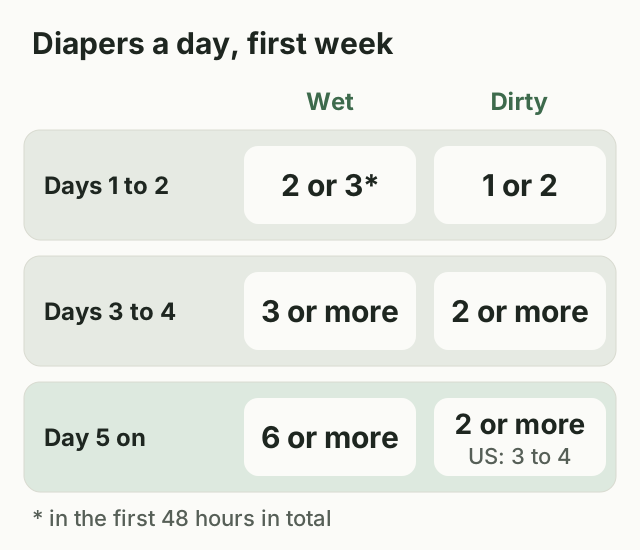
- First 48 hours: the NHS says your baby is likely to have only 2 or 3 wet diapers in total. La Leche League looks for two wet diapers over 24 hours by day 2.
- Days 3 and 4: La Leche League looks for 3 or more wet diapers every 24 hours.
- From day 5: the NHS, the AAP and La Leche League all expect 6 or more wet diapers every 24 hours. The AAP adds that the pee should be nearly colorless or pale yellow.
Dirty diapers
- Days 1 and 2: 1 or 2 poops a day, according to the AAP.
- Days 3 and 4: at least 2 a day, per the AAP.
- From day 4 or 5: the NHS says at least 2 soft, yellow poops a day, each about the size of a £2 coin, for the first few weeks. The AAP says at least 3 to 4 a day by 5 to 7 days old. So in the UK the minimum is 2 and in the US it is 3 to 4. Your own care team will tell you which they use.
The AAP also notes that many breastfed babies poop with almost every feed in the first month.
Modern disposable diapers soak up so much that a wet one can feel dry. The NHS suggests pouring 2 to 4 tablespoons of water into a clean diaper once, so you know what “properly wet” feels like.
How poop changes in the first week
The first poop is meconium. HealthyChildren.org describes it as a thick black or dark green substance that filled the intestines before birth. As milk comes in, the color moves toward yellow.
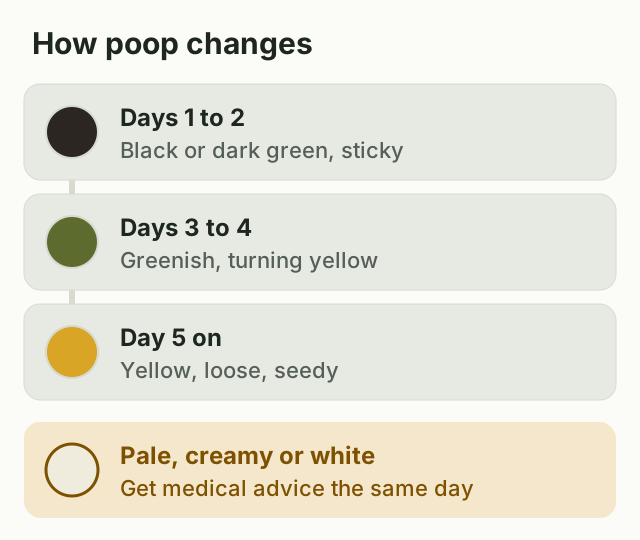
According to the AAP, stools are blackish and tarry on days 1 and 2, greenish to yellow on days 3 and 4, and yellow and loose with small curds by 5 to 7 days old. After that, green stools now and then are not unusual and, in the AAP’s words, should not cause alarm.
Pee can surprise you too. In the first week, HealthyChildren.org says a pinkish or brick-red stain in the diaper is usually a sign of very concentrated urine. If it keeps happening, talk to your pediatrician.
When to call
Call 999 in the UK (or your local emergency number), or go to the emergency department, if your baby has not produced any wet diapers, is not feeding, or is sleepier than normal and hard to wake. These are among the NHS’s emergency signs for a baby with jaundice.
Get an urgent appointment the same day, or call NHS 111 in the UK, if:
- poop is a pale creamy or white color, or pee is dark yellow or brown. Keep a sample of the poop to show the midwife or doctor (NHS)
- your baby has fewer wet diapers than usual, few or no tears when crying, a soft spot on the head that sinks inwards, or is drowsy or irritable. These can be signs of dehydration (NHS)
- you see blood in the urine or a bloody spot on the diaper, which is never normal (AAP)
- the pink or brick-red staining keeps showing up after the first days (AAP)
If none of these apply but the counts sit below the ranges above, do not wait for the next check-up. Call your midwife, health visitor, pediatrician or a breastfeeding specialist and tell them what you have counted.
How a log helps at the appointment
When you are asked “how many wet diapers yesterday?”, tiredness makes the honest answer “I’m not sure”. If two of you share the changes, each of you only knows half.
A log turns the question into something you can read off a screen. A few habits make it more useful:
- Log each change as it happens. Wet, dirty or both takes a second, and a count rebuilt from memory at the end of the day is a guess.
- Look at the last 24 hours, not the calendar day. The guidance talks about every 24 hours, and a check-up at 10 in the morning covers a night and half a day.
- Write down what looks different. A pale color, a pink stain or a very hard stool is worth a short note, so you can describe it accurately later.
- Keep both caregivers in the same record. Otherwise the night changes and the day changes never add up.
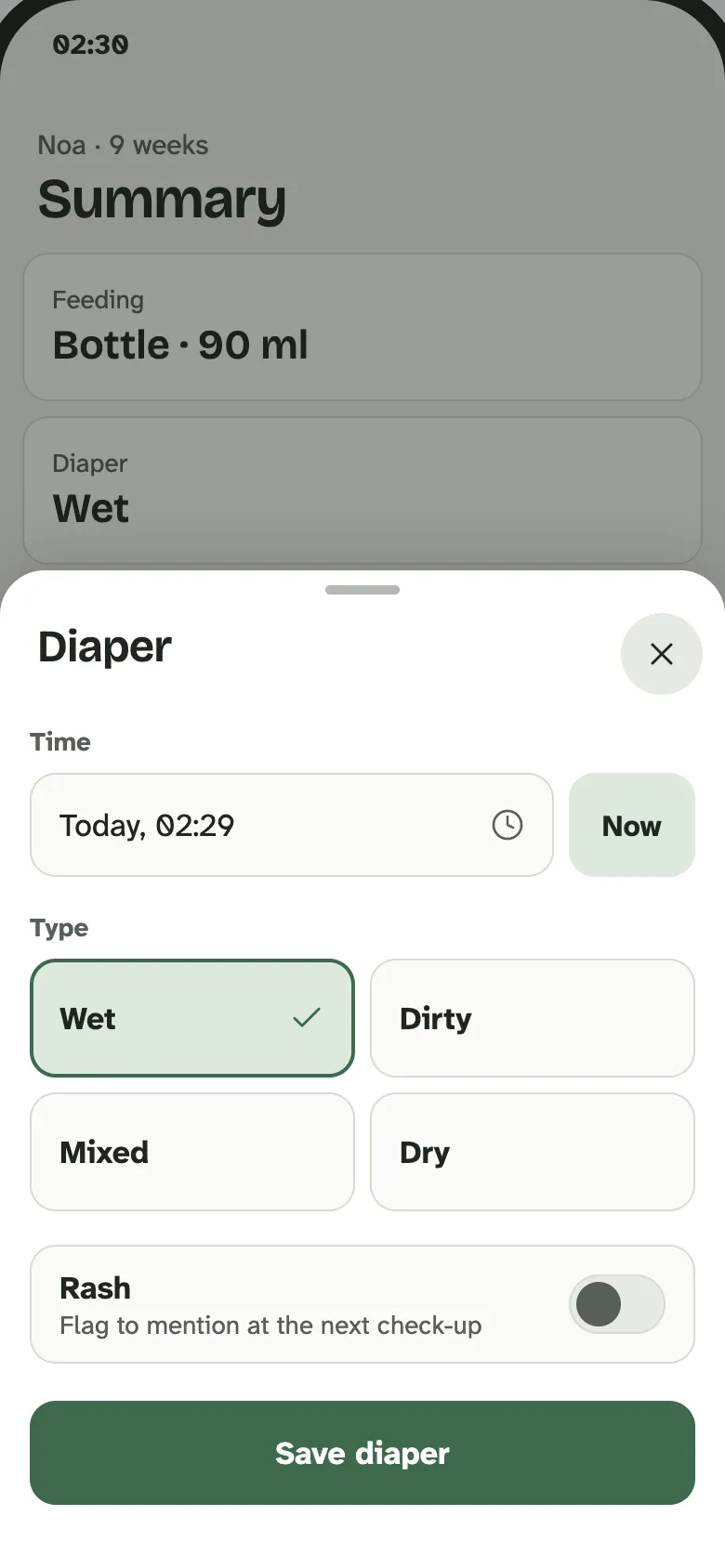
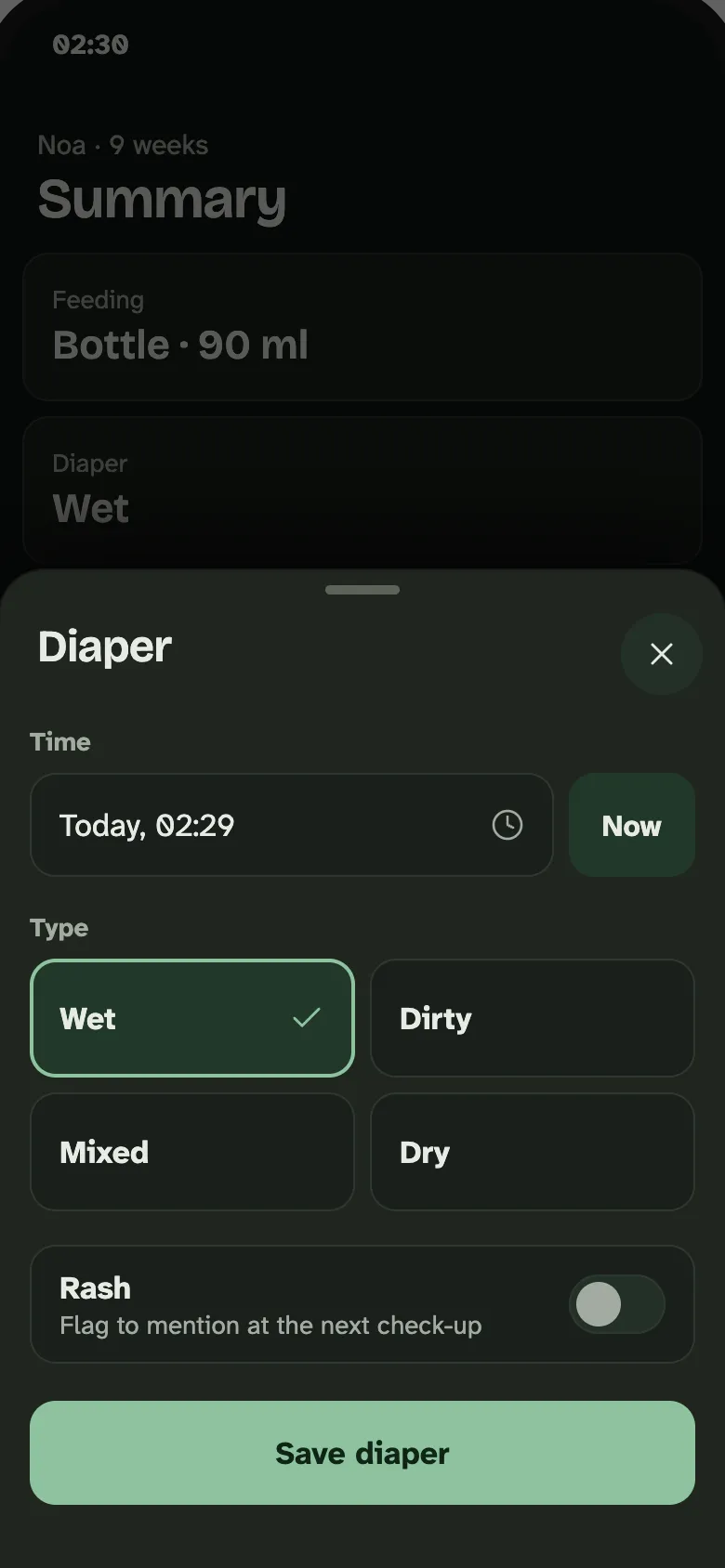
In Baby Tracker by Alder, each change is one tap for wet, dirty or both, with an optional note, and the app shows the daily wet and dirty counts. Both caregivers log into the same record, so at the appointment you can show the last few days instead of guessing.
After the first weeks
The day-by-day ranges above cover the first week, when your team is checking that feeding has got going. Weight gain then becomes the main measure, checked at your baby’s appointments. Ask your care team what they want you to watch for after that, keep logging if it helps you, and mention any big change at the next check-up.
Sources
- Breastfeeding: is my baby getting enough milk?, NHS
- Jaundice in babies, NHS
- Dehydration, NHS
- How to Tell if Your Breastfed Baby is Getting Enough Milk, American Academy of Pediatrics (HealthyChildren.org)
- Baby’s First Days: Bowel Movements and Urination, American Academy of Pediatrics (HealthyChildren.org)
- Is my baby getting enough milk?, La Leche League International
All accessed 14 October 2026.
Common questions
How many wet diapers should a newborn have?
In the first 48 hours, the NHS says only 2 or 3 wet diapers in total is likely. La Leche League looks for 3 or more a day on days 3 and 4. From day 5, the NHS, the AAP and La Leche League all expect 6 or more wet diapers every 24 hours.
When does newborn poop turn yellow?
According to the AAP, stools are blackish and tarry on days 1 and 2, greenish to yellow on days 3 and 4, and yellow and loose with small curds by 5 to 7 days old.
How can I tell if a disposable diaper is wet?
The NHS suggests pouring 2 to 4 tablespoons of water into an unused diaper, so you can feel what a properly wet one is like.
Is pale poop a reason to call the doctor?
Yes. The NHS lists poop that is a pale creamy color, or pee that is dark yellow or brown, as a reason for an urgent appointment or a call to NHS 111. Keep a sample to show the midwife or doctor.
This guide is general information, not medical advice. Talk to your midwife, health visitor or doctor about your baby's health.