Key points
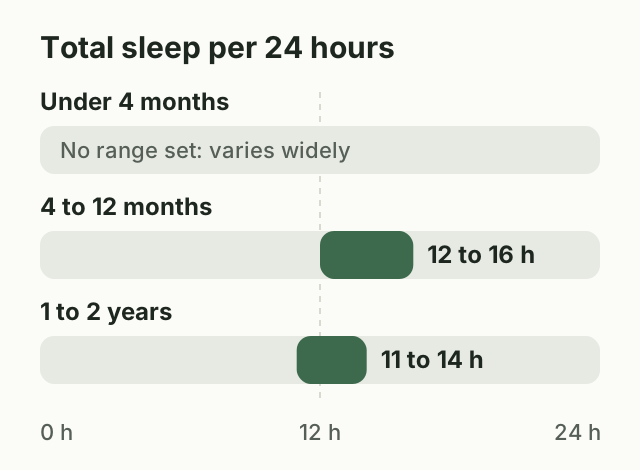
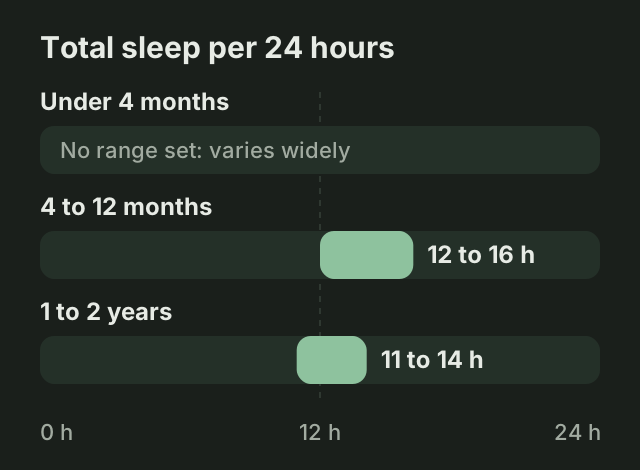
- From 4 to 12 months, the AASM recommends 12 to 16 hours of sleep per 24 hours, naps included. There is no range for babies under 4 months.
- A start and stop time for each sleep is enough. A week of rough entries shows the rhythm better than one exact day.
- Every nap is a safe sleep: on the back, in a clear cot, in your room for at least the first 6 months.
- A baby who is difficult to wake or cannot be woken needs emergency help.
Some days the naps are long and easy. Other days they are short, late or happen in a pram. If you try to record every minute, the log soon becomes one more thing to worry about. The good news: you do not need exact minutes. A rough start and stop time for each sleep is enough to see what really matters, which is the pattern over a week.
How much sleep babies need in the first year
The most widely used figures come from the American Academy of Sleep Medicine (AASM). The American Academy of Pediatrics supports these guidelines. The numbers are total sleep per 24 hours, and they include naps:
- 4 to 12 months: 12 to 16 hours.
- 1 to 2 years: 11 to 14 hours.
There is no recommended range for babies under 4 months. The AASM consensus statement explains why: sleep at this age varies widely in both length and pattern, and there is not enough evidence to link a number to health outcomes.
The NHS describes it in a similar way. Its page on helping your baby to sleep says a newborn’s total daily sleep varies but can be around 18 hours. Between 3 and 6 months some babies sleep 5 to 8 hours or longer at night, “but not all”. Between 6 and 12 months some babies sleep around 15 hours, mostly at night.
These are ranges, not targets for a single day. The NHS puts it simply: your baby will have their own pattern of waking and sleeping, and it is unlikely to be the same as other babies you know.
Why the pattern matters more than the minutes
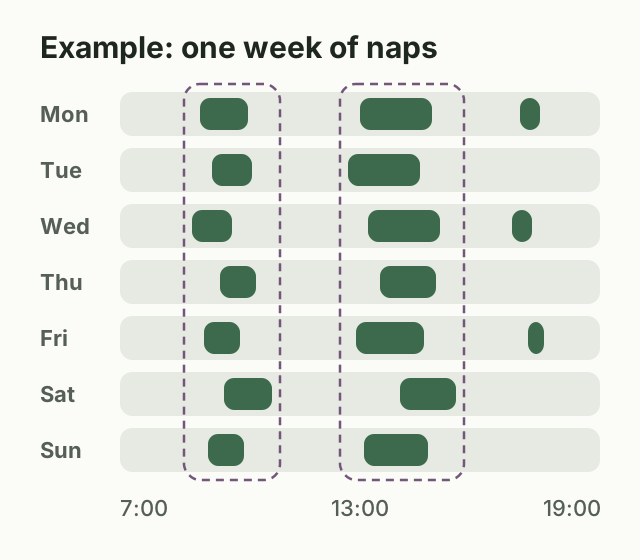
A single day tells you very little. One short nap might be a busy morning, a noisy street or a feed that ran late. What helps you is the shape of several days side by side:
- Roughly when the first nap of the day tends to start.
- Whether there are usually two naps, three, or a short extra one late in the afternoon.
- How the total for the day compares with the total for the night.
- What changes when a nap is missed.
None of this needs minute-by-minute precision. If a nap started “about ten past nine”, writing 9:10 is close enough. Ten minutes either way will not change the picture across a week.
There is another reason to keep it light. HealthyChildren.org notes that your pediatrician may ask you to keep a sleep log if there are concerns about sleep. A log you can keep going for a week or two is far more useful than a perfect one you give up after two days. The AASM statement also says parents who are worried their child sleeps too little or too much should talk to their healthcare provider, and a simple log gives you something concrete to bring.
A simple start and stop log
Here is a low-effort way to log naps that still shows the rhythm:
- Note when your baby falls asleep. Not when you started settling them, just when they drifted off.
- Note when they wake. Again, roughly is fine.
- Add a word only if something was different. For example “in the car”, “teething” or “skipped”.
- Look at the week, not the day. Once a week, glance over all the entries together.
That is all. No ratings, no tracking of every stir. Over a few days, clusters start to show: a morning nap that keeps landing around the same time, an afternoon nap that is the longest of the day, a late catnap that comes and goes.
If you forget to log a nap when it starts, add it when your baby wakes with your best guess for the start time. A rough entry keeps the week complete, and that matters more than accuracy to the minute.
Logging sleep in Baby Tracker
In Baby Tracker you start a timer when your baby drifts off and stop it when they wake. The timer keeps running in the background, and naps and night sleep add up to daily totals for you. If you started the timer late, you can adjust the “Fell asleep” time before you save.
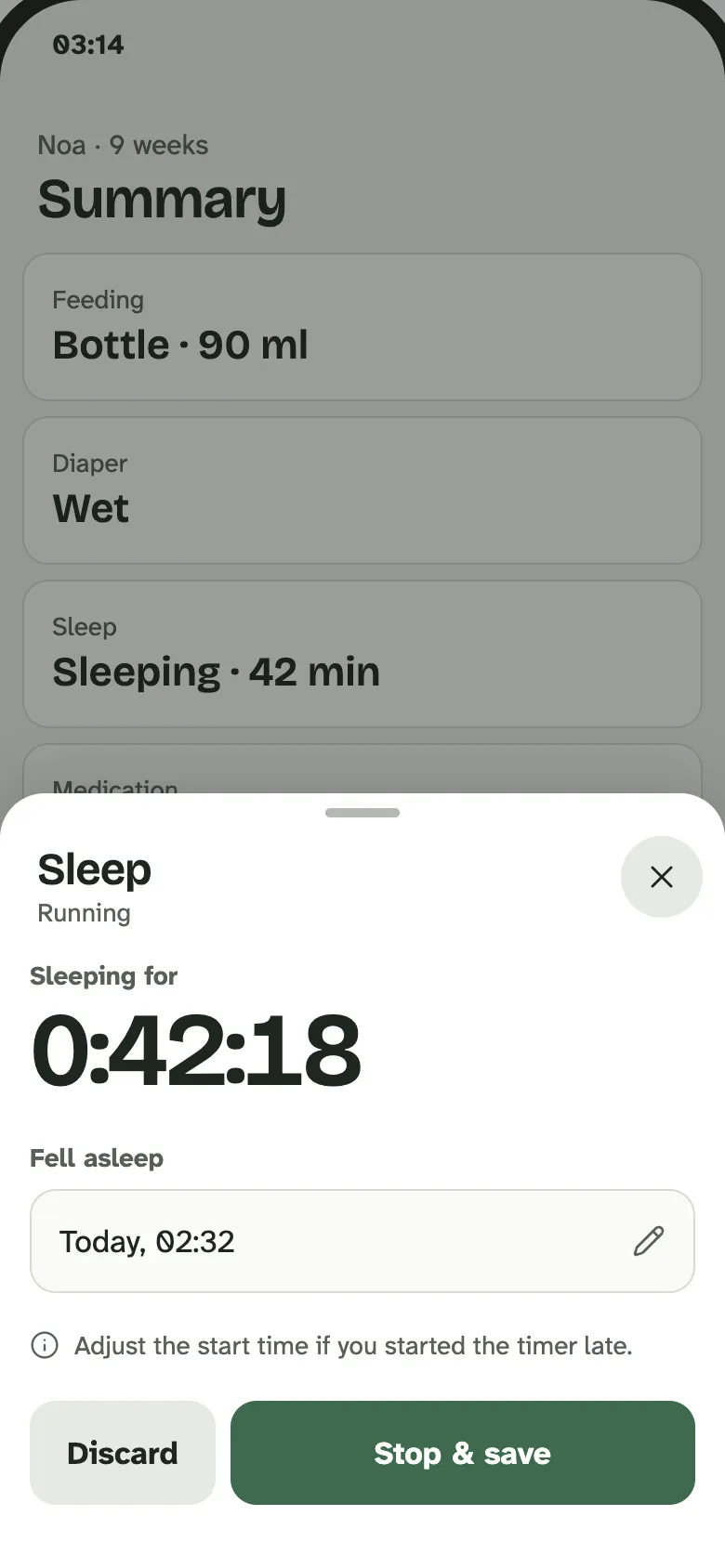
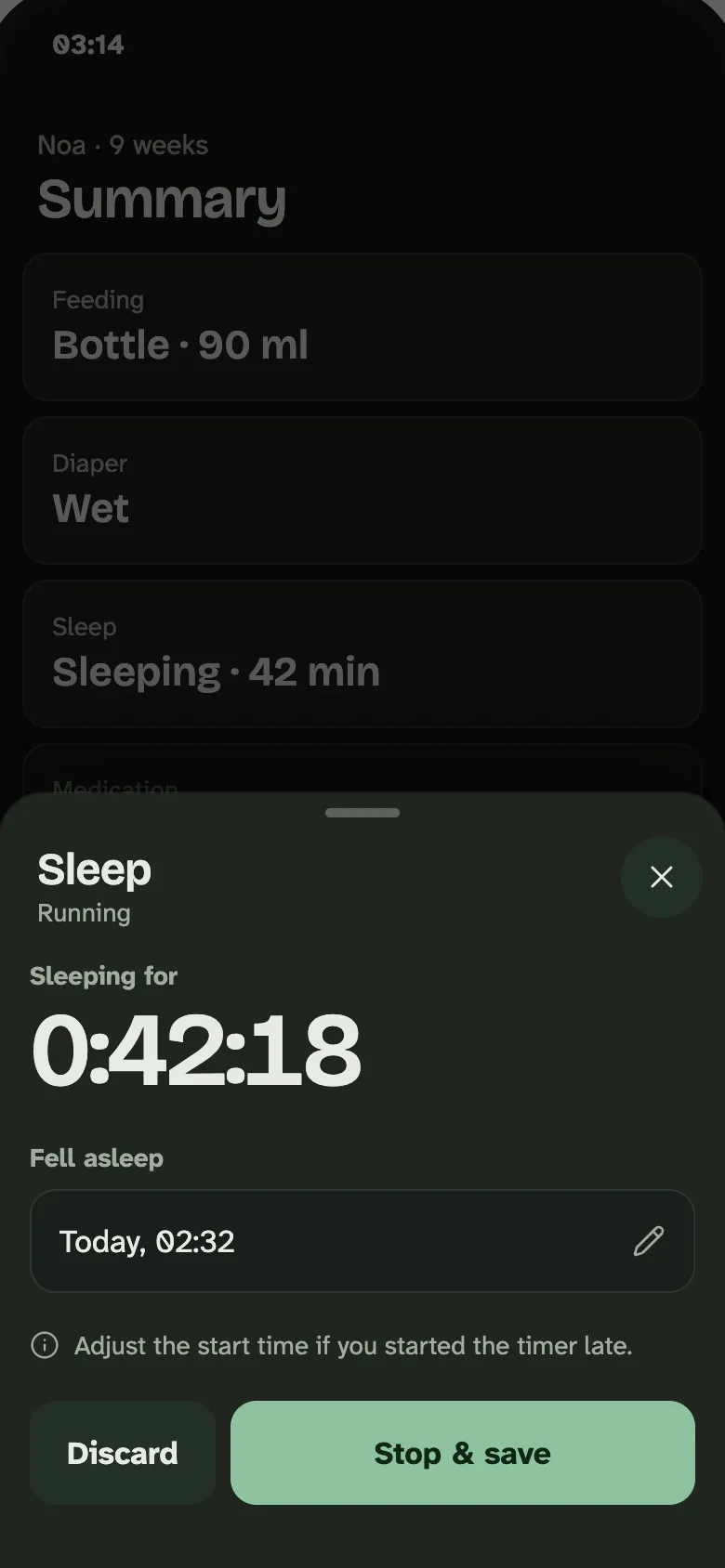
Because two caregivers share the same record, whoever is with the baby can start or stop the timer, and the other person sees it too. That makes the weekly pattern easier to keep complete, even when naps happen with different people.
Safe sleep basics for every nap
Naps count as sleep, so the same safety advice applies in the day as at night. The NHS and the AAP agree on the main points:
- On the back, every time. The AAP says to place your baby on their back for all naps and at night. The NHS adds the feet-to-foot position, with your baby’s feet at the bottom of the cot or Moses basket.
- A firm, flat surface. The AAP says the surface should not indent when your baby lies on it, and anything inclined more than 10 degrees is not safe for sleep.
- A clear cot. The AAP says a fitted sheet only, with no soft objects or loose bedding. The NHS says to keep the cot clear of anything that could cover your baby’s face and head.
- Your room, their own space. Both say to keep your baby in the same room as you for at least the first 6 months, day and night, in their own cot or Moses basket. The AAP advises against bed sharing.
- Not too warm. The NHS suggests a room temperature of about 16 to 20C. The AAP says not to let your baby get overheated.
- No smoke. The NHS advises not smoking in pregnancy or around your baby.
The AAP notes these recommendations apply to babies up to 1 year of age.
The NHS says to call 999 (outside the UK, your local emergency number) or go to the emergency department if your baby:
- is difficult to wake or cannot be woken, or has fainted
- is breathing very fast or has difficulty breathing, for example grunting or sucking in their tummy
- has blue, grey, pale or blotchy skin, lips or tongue
- has a weak, high-pitched or continuous cry
- is having a seizure (fit)
If you are worried about any symptom or do not know what to do, call NHS 111 (in the UK) or your doctor.
Keep it light
You do not have to measure sleep to look after it. A start and stop time, a word when something was different, and a weekly look back are enough to see your baby’s rhythm and to answer your doctor’s questions. On busy days, a rough entry is still a good entry.
Sources
- Health Advisory: Child Sleep Duration, American Academy of Sleep Medicine
- Recommended Amount of Sleep for Pediatric Populations: A Consensus Statement, American Academy of Sleep Medicine (J Clin Sleep Med 2016)
- Healthy Sleep Habits: How Many Hours Does Your Child Need?, HealthyChildren.org (American Academy of Pediatrics)
- How to Keep Your Sleeping Baby Safe: AAP Policy Explained, HealthyChildren.org (American Academy of Pediatrics)
- Helping your baby to sleep, NHS
- Sudden infant death syndrome (SIDS), NHS
- When to get urgent medical help for babies and children under 5, NHS
All sources accessed 14 October 2026.
Common questions
How many hours should my baby sleep in a day?
The American Academy of Sleep Medicine, supported by the AAP, recommends 12 to 16 hours per 24 hours, including naps, for babies aged 4 to 12 months, and 11 to 14 hours for 1 to 2 year olds. It sets no range for babies under 4 months because normal sleep varies so widely. The NHS says newborns can sleep around 18 hours in total.
Do naps count towards total sleep?
Yes. The AASM ranges are per 24 hours and include naps, so add daytime and night sleep together when you look at the total.
Do I need to time every nap to the minute?
No. A start time and an end time, even rounded, are enough to see the pattern across a week. Your doctor may ask you to keep a sleep log, and a simple one is easier to keep going.
Can my baby nap on their front if I am watching?
The NHS and the AAP both say to place your baby on their back for every sleep, naps included, on a firm, flat surface with nothing else in the cot.
This guide is general information, not medical advice. Talk to your midwife, health visitor or doctor about your baby's health.