Key points
- Newborns usually feed at least 8 to 12 times every 24 hours, so log the time of each feed
- From day 5, expect at least 6 heavy, wet diapers a day
- Most babies are back to their birth weight by about 2 weeks
- Skip minute-perfect times and burps: patterns matter more than precision
The first two weeks with a newborn are a blur of feeds, changes and short stretches of sleep. Someone at a check-up will probably ask “how many wet diapers today?” or “when did they last feed?”, and at 4am it is hard to remember. A simple log answers those questions for you.
The trick is to log the few things that tell you whether your baby is feeding well and growing, and to let the rest go.
Why the first two weeks are different
In these early days your midwife, health visitor or pediatrician watches a few signs closely. They want to see that feeding is getting established, that your baby is passing enough urine and stool, and that weight is coming back after the normal early dip.
All of those signs are things you can count at home. You do not need special equipment, only a quick note each time.
What to log
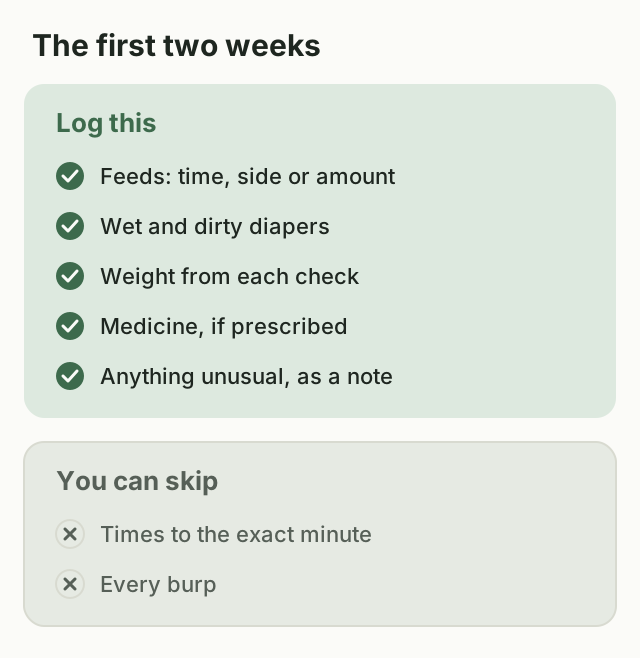
Feeds
Newborns feed often. The NHS says that, as a very rough guide, babies feed at least 8 to 12 times or more every 24 hours in the first few weeks, and in the first few days it could be every 1 to 3 hours. The AAP and the CDC give the same range of 8 to 12 times in 24 hours.
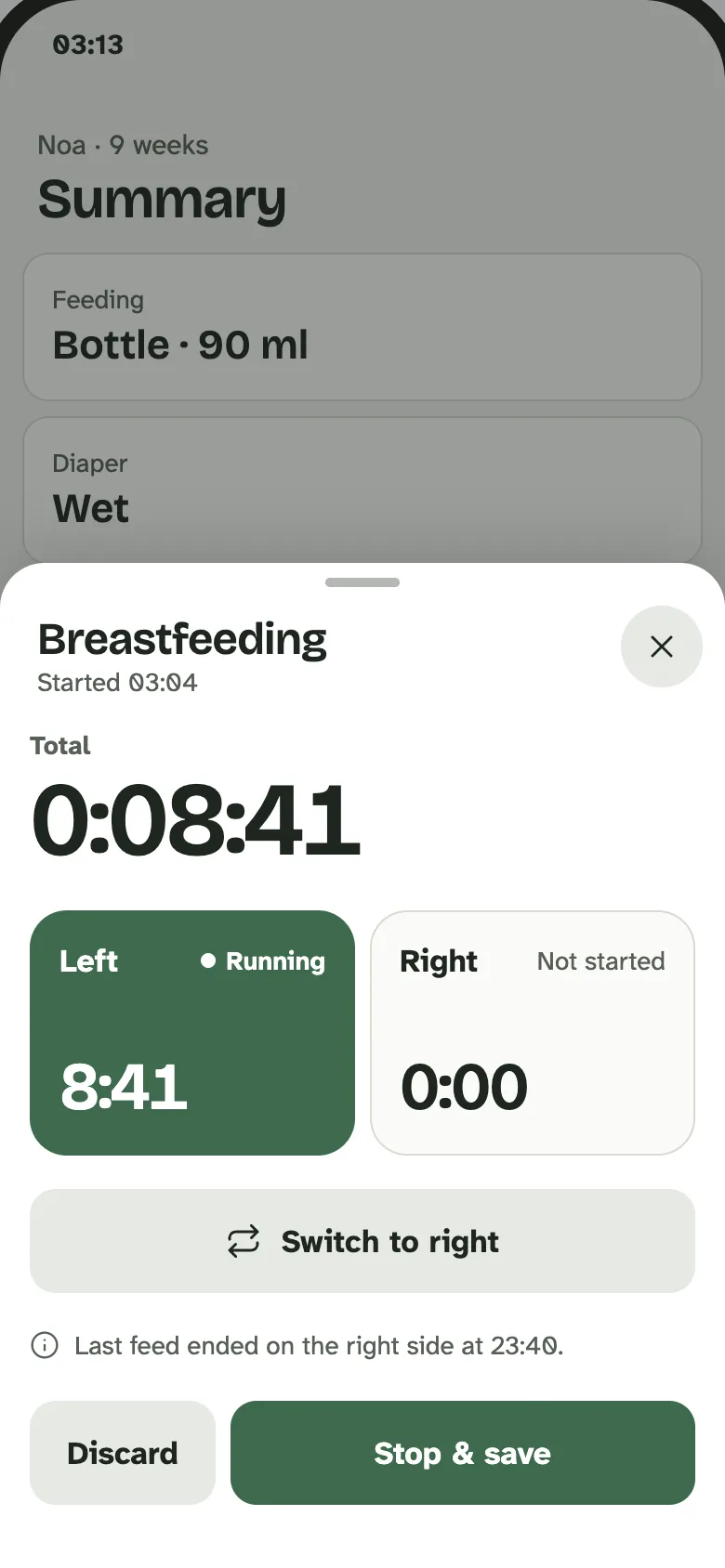
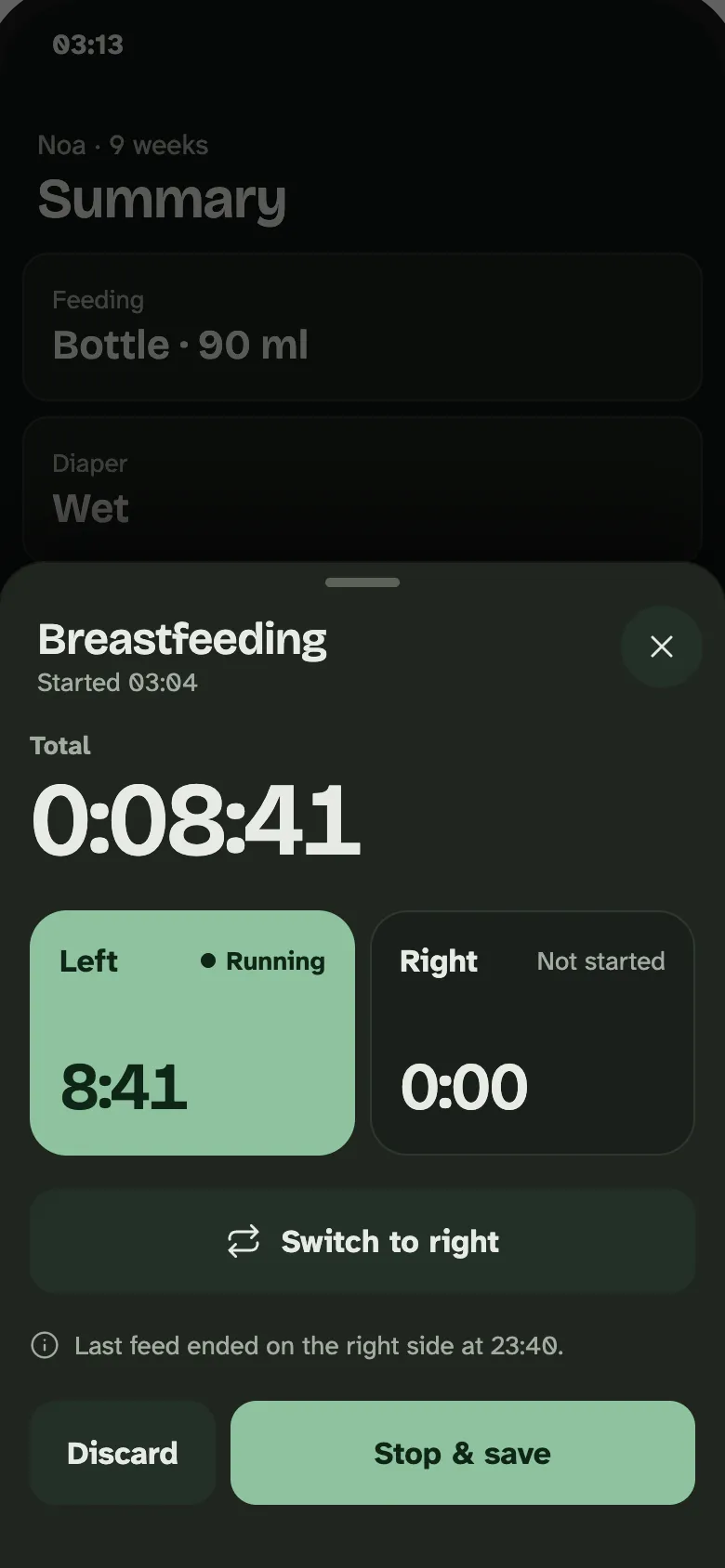
For each feed, note the start time. If you breastfeed, note which side you finished on, so you know where to start next time. If you bottle feed, note the amount and whether it was formula or expressed milk.
You do not need a perfect record. What matters is being able to look back and see roughly how many feeds happened in the last day.
Wet and dirty diapers
Diapers are one of the clearest signs that your baby is getting enough milk. The NHS says:
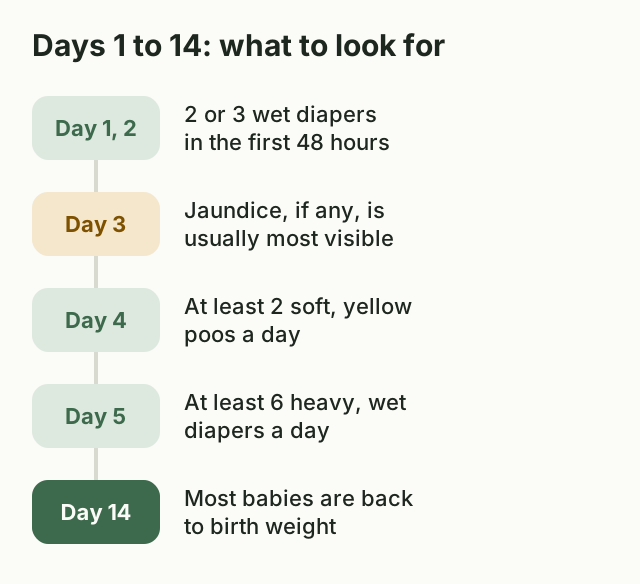
- In the first 48 hours, your baby is likely to have only 2 or 3 wet diapers.
- From day 5, wet diapers should become more frequent, with at least 6 heavy, wet diapers every 24 hours.
- From day 4, a breastfed baby should do at least 2 soft, yellow poos every day for the first few weeks.
The AAP adds that the first stools are dark and sticky, turn greenish to yellow around days 3 to 4, and by 5 to 7 days old should be yellow and loose. A tap for “wet”, “dirty” or “both” is all you need. Add a short note if the colour looks different.
Weight from each check
It is normal for babies to lose some weight in the first few days. The NHS says most babies are at, or above, their birth weight by 2 weeks, and your baby will be weighed during these first weeks to check. The AAP says steady gains usually start around day 5, and almost all babies have regained their birth weight by 3 weeks.
You will not weigh your baby at home. Just write down the weight from each visit with the date, so you can see the trend and answer questions at the next appointment.
Medicine, if prescribed
Most newborns need no medicine. If your baby is prescribed something, log each dose with the time. When two people share care, this is the entry that prevents a dose being given twice or missed.
Anything unusual
A short note is worth more than a perfect timestamp. Write down things like “skin looks more yellow today” or “very sleepy, hard to wake for this feed”. If you call someone later, you will have the details at hand.
What you can skip
Times to the exact minute
Whether a feed started at 2:13 or 2:20 makes no difference. Round to the nearest few minutes, or log the feed when it ends and adjust the start time later. The pattern across the day is what tells you something.
Every burp, hiccup and yawn
Burps, hiccups and small spit-ups are part of feeding. Logging each one adds work without adding information. Only note something if it seems out of the ordinary, such as a lot more spit-up than usual.
Long notes for every entry
Keep notes for things that are different. If every entry has a note, the important ones get lost.
If two of you share the night, agree on one rule: whoever does the feed or change logs it straight away. Then the other person can check the record instead of waking you to ask.
A day-by-day view
The figures from the NHS give you a few simple checkpoints to keep in mind.
Jaundice: what to watch
Many babies look a little yellow in the first days. The NHS says jaundice is usually most noticeable when a baby is around 3 days old and usually takes around 2 weeks to go. Look at the whites of the eyes and the skin, which may yellow from the face and head first.
Note it if you see it, and note the colour of pee and poo too. In the US, the AAP lists urine or stool that looks abnormal among the reasons to check in with your pediatrician.
When to call your midwife or doctor
The NHS says to ask for an urgent GP or midwife appointment, or call NHS 111, if your baby is over 24 hours old and:
- you think they have jaundice, or jaundice is not getting better or is getting worse
- their pee is dark yellow or brown, or their poo is a pale, creamy colour
Call 999 in the UK (elsewhere, your local emergency number) or go to the emergency department if your baby has jaundice and is under 24 hours old, is sleepier than normal or hard to wake, is not feeding, is floppy or stiff or has jerking movements, has a temperature of 38C or higher or 36C or lower, is not having wet diapers, or has trouble breathing.
The AAP says to talk to your pediatrician if your baby is under birth weight at two weeks, or has fewer than 6 wet diapers and 4 stools a day after day 7.
If something feels wrong and it is not on any list, call anyway. Your log helps you describe what happened, but your instinct is reason enough.
Sources
- Breastfeeding: the first few days, NHS
- Breastfeeding: is my baby getting enough milk?, NHS
- Your baby’s weight and height, NHS 111 Wales
- Jaundice in babies, NHS
- How to Tell if Your Breastfed Baby is Getting Enough Milk, American Academy of Pediatrics (HealthyChildren.org)
- Warning Signs of Breastfeeding Problems, American Academy of Pediatrics (HealthyChildren.org)
- Your Baby’s First Month: Growth and Physical Appearance, American Academy of Pediatrics (HealthyChildren.org)
- How Much and How Often to Breastfeed, CDC
All accessed 14 October 2026.
Common questions
How often should a newborn feed in the first two weeks?
As a rough guide, the NHS and the AAP say at least 8 to 12 times every 24 hours, and early on it can be every 1 to 3 hours. Feed whenever your baby seems hungry.
How many wet diapers should a newborn have?
The NHS says 2 or 3 wet diapers in the first 48 hours, then at least 6 heavy, wet diapers every 24 hours from day 5.
When should my baby be back to birth weight?
It is normal for babies to lose some weight in the first few days. Most are at or above their birth weight by 2 weeks. If yours is not, your midwife, health visitor or pediatrician will help.
Do I need to log every feed to the minute?
No. The start time of each feed is enough to see the pattern. Exact durations and every burp add work without telling you much more.
This guide is general information, not medical advice. Talk to your midwife, health visitor or doctor about your baby's health.