Key points
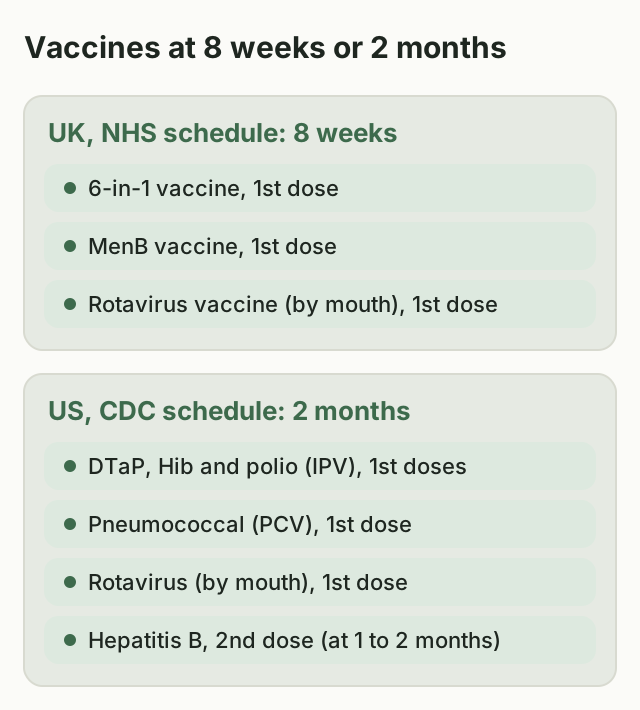
- In the UK, babies are offered the 6-in-1, MenB and rotavirus vaccines at 8 weeks
- In the US, the CDC schedule lists DTaP, Hib, polio, pneumococcal and rotavirus at 2 months, plus hepatitis B dose 2 at 1 to 2 months
- Bring your baby's health record and clothes that make the thighs easy to reach
- Mild fever, fussiness and a sore leg are common and usually pass in 1 or 2 days
The first round of baby vaccines often lands when you are still finding your feet. Knowing what will happen, what to bring and what is normal afterwards makes the day calmer for you, and that helps your baby too.
This guide covers the UK (8 weeks) and the US (2 months). If you live somewhere else, your country has its own schedule, and the visit may look different.
Which vaccines are given at this visit
In the UK: 8 weeks
The NHS routine schedule offers three vaccines at 8 weeks:
- 6-in-1 vaccine, 1st dose. It protects against diphtheria, tetanus, whooping cough, polio, Hib and hepatitis B.
- MenB vaccine, 1st dose, against meningococcal group B.
- Rotavirus vaccine, 1st dose, against rotavirus gastroenteritis. It is given by mouth, not as an injection.
The two injections go in the thigh. According to the UKHSA complete routine immunisation schedule, the rotavirus vaccine is only given after checking your baby’s newborn screening result for SCID, a rare immune condition. The same three vaccines are given again at 12 weeks, and the 6-in-1 and the pneumococcal vaccine follow at 16 weeks.
In the US: 2 months
The CDC child immunization schedule currently published on cdc.gov (the 2025 edition) lists these at 2 months:
- DTaP, Hib and polio (IPV), 1st doses.
- Pneumococcal conjugate (PCV), 1st dose.
- Rotavirus, 1st dose, given by mouth.
- Hepatitis B, 2nd dose, which the CDC schedule notes place at 1 to 2 months.
Some of these may come as a combined shot, so your baby may get fewer injections than the list suggests. US guidance has also been changing: in January 2026 the CDC removed rotavirus and hepatitis B from its routine childhood list, while the American Academy of Pediatrics still recommends both. Ask your pediatrician which schedule their practice follows.
Elsewhere in Europe
Every EU and EEA country sets its own schedule. The ECDC Vaccine Scheduler lets you look up and compare national schedules by country and age. ECDC itself notes that national websites have the most up-to-date recommendations, so check with your local health service too.
Before the appointment
A little preparation goes a long way. The NHS tips for parents suggest:
- Bring your baby’s health record. In England this is usually the red book. In the US, bring whatever record your pediatrician gave you.
- Dress for easy access. Babies under 12 months have injections in the thigh, so choose clothes that come off quickly.
- Leave extra time, so neither of you feels rushed.
- Tell the clinic if someone else is taking your baby.
It also helps to write down your questions beforehand. A few that parents often ask:
- Which vaccines is my baby getting today, and which are combined?
- What reactions should I expect, and what should I do about a fever?
- When is the next appointment?
The CDC suggests bringing a comforting item such as a favourite blanket, and asking early about a numbing cream, since it takes time to work.
During the visit
Stay as calm as you can. Babies pick up on our stress. The NHS suggests holding your baby on your knee, or asking a nurse to hold them if you find it hard to watch.
The CDC notes that breastfeeding can help calm and relax your baby during the shots, and that for children two and under you can ask about a sweet sucrose or glucose solution given shortly before. Afterwards, a cuddle and a feed usually help.
After the vaccines: what is normal
Most reactions are mild and short. The NHS 6-in-1 page and MenB page list swelling or pain where the injection was given, a high temperature, tiredness, irritability, loss of appetite, and vomiting or diarrhoea. MenB side effects usually get better within 1 or 2 days. The CDC says mild reactions go away within a day or two.
After the rotavirus vaccine, the NHS says diarrhoea and irritability are common. For a few weeks, your baby’s poo may contain a weakened form of the virus, so wash your hands well after every nappy change.
Paracetamol after MenB (UK)
In the UK, the NHS recommends liquid paracetamol after the MenB vaccine at 8 and 12 weeks, to prevent or treat a fever. Give 3 doses: the first as soon as possible after the vaccination, the second 4 to 6 hours later, and the third 4 to 6 hours after that. Check the dose for your baby’s age on the packaging or ask a pharmacist. Never give aspirin to children under 16 unless a doctor prescribes it.
In the US, the CDC advises asking your child’s doctor before giving any pain reliever.
The NHS says to ask for an urgent GP appointment or call NHS 111 (outside the UK, your doctor or local urgent care line) if your baby:
- is under 3 months old and has a temperature of 38C or higher, or you think they have a high temperature
- still has a high temperature more than 48 hours after the vaccine
- is unwell and you are worried about them
After the rotavirus vaccine, also get urgent advice if your baby keeps being sick, has blood in their poo or poo that looks like redcurrant jelly, has a swollen or painful tummy, stops feeding or has fewer wet nappies, or has diarrhoea for more than 7 days.
In the US, the CDC says to contact your child’s doctor if anything concerns you.
Logging the vaccines and any reactions
Your official record is the one the clinic keeps and the book or card they sign. A shared log at home is handy for the details you will want later: what was given, on which date, how your baby slept and fed that evening, and when you gave any paracetamol.
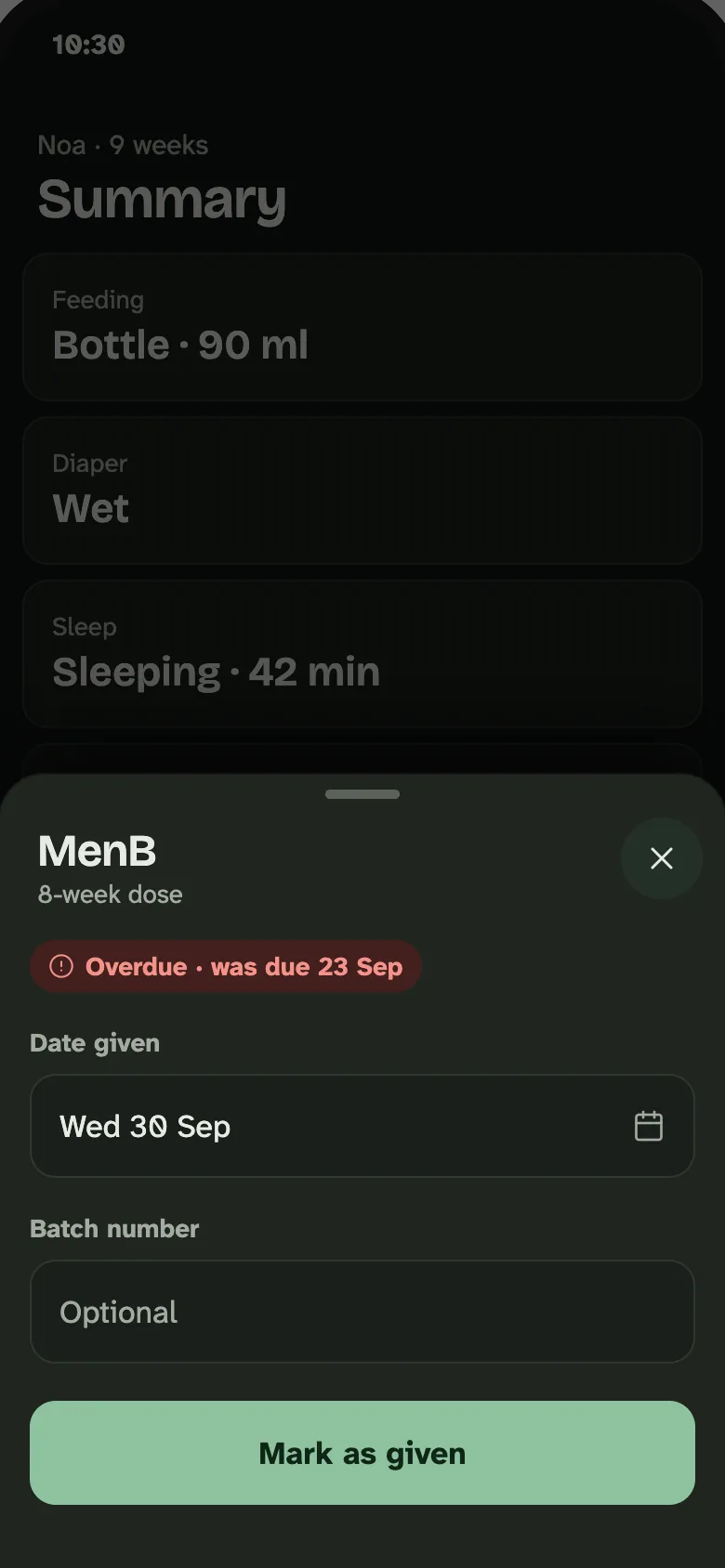
In Baby Tracker, the Vaccines screen shows which vaccines are given, due, overdue or upcoming, grouped by age. You record each one with its date, and the person who logged it is shown, so you and your partner see the same record. Medicine doses go in with the time, so whoever is on duty at 2am can see when the last dose of paracetamol was given.
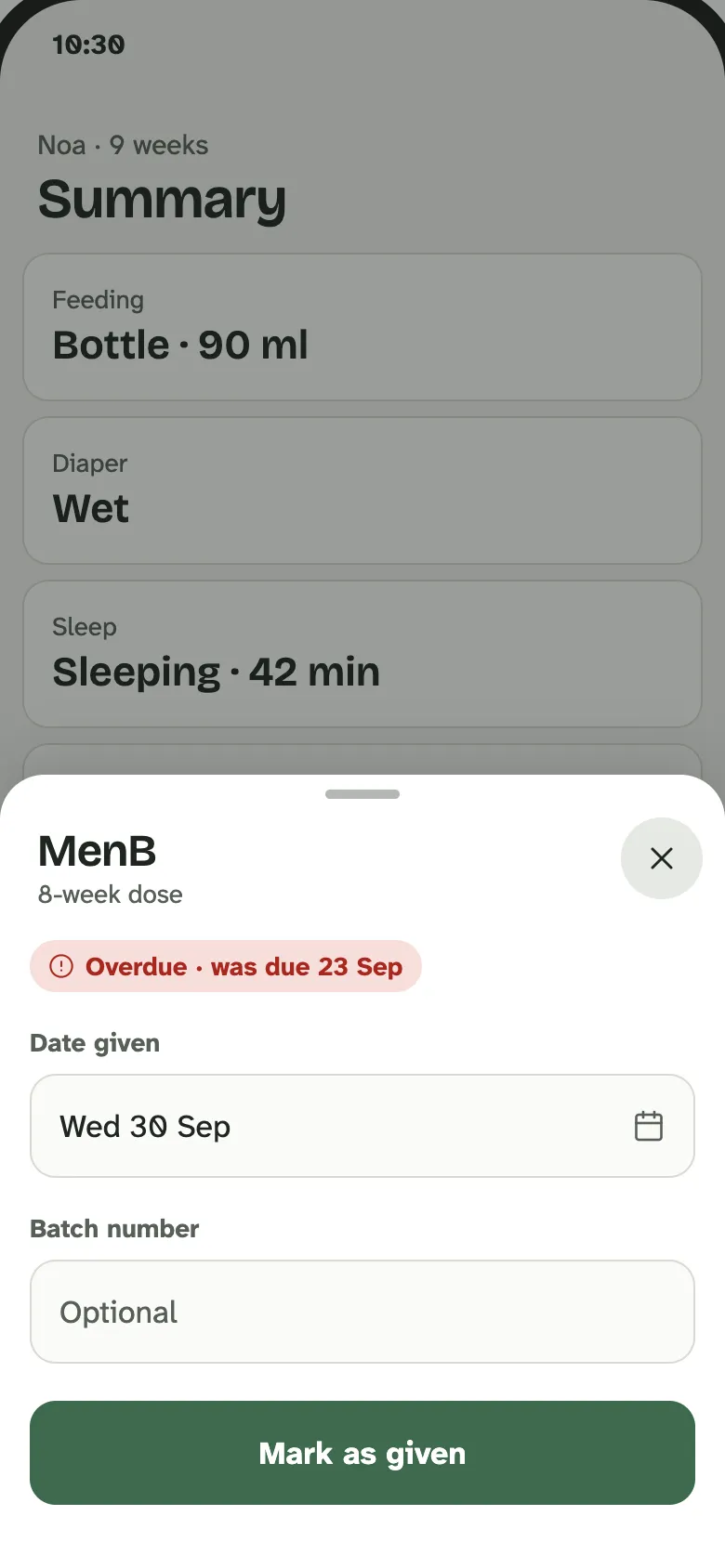
Write down the next appointment date before you leave the clinic. In the UK, the next round is at 12 weeks; in the US, the next visit on the CDC schedule is at 4 months.
Sources
- NHS vaccinations and when to have them, NHS
- Complete routine immunisation schedule from 1 September 2026, UKHSA
- 6-in-1 vaccine, NHS
- MenB vaccine, NHS
- Rotavirus vaccine, NHS
- Vaccination tips for parents, NHS
- Child and Adolescent Immunization Schedule by Age, CDC
- Child and Adolescent Immunization Schedule Notes, CDC
- Make Shots Less Stressful for Your Child, CDC
- What is the difference between the AAP recommended immunization schedule and other vaccine schedules?, American Academy of Pediatrics (HealthyChildren.org)
- Vaccine Scheduler, ECDC
All sources accessed 14 October 2026.
Common questions
Which vaccines does my baby get at 8 weeks in the UK?
The NHS routine schedule offers the first doses of the 6-in-1 vaccine, the MenB vaccine and the rotavirus vaccine at 8 weeks. The rotavirus vaccine is given by mouth.
Which vaccines are given at 2 months in the US?
The schedule published by the CDC (2025 edition) lists the first doses of DTaP, Hib, polio (IPV), pneumococcal (PCV) and rotavirus at 2 months, and the second hepatitis B dose at 1 to 2 months. US guidance changed in 2026, so ask your pediatrician which schedule they follow.
Should I give paracetamol after the 8-week vaccines?
In the UK, the NHS recommends liquid paracetamol after the MenB vaccine at 8 and 12 weeks to lower the chance of a fever: 3 doses, the first as soon as possible after the vaccination and then 4 to 6 hours apart. Check the dose on the packaging or ask a pharmacist.
When should I call a doctor after the vaccines?
The NHS says to ask for an urgent GP appointment or call 111 if a baby under 3 months has a temperature of 38C or higher, if a high temperature lasts more than 48 hours after the vaccine, or if your baby is unwell and you are worried.
This guide is general information, not medical advice. Talk to your midwife, health visitor or doctor about your baby's health.