
Key points
- Log the time, the side and the amount of every session
- To build supply, NHS guidance suggests 8 to 10 sessions in 24 hours, including one at night
- Storage times differ: the CDC says up to 4 days in the fridge, the NHS up to 8 days at 4°C or lower
- Label every container with the date and use the oldest milk first
When one parent pumps and the other gives the bottle, the milk passes between two people who may not be awake at the same time. A shared log closes that gap. Whoever pumped writes down what they got and when, and whoever feeds next knows what is in the fridge, how old it is and which container to use first.
This article covers what to record, how often people usually express, how long milk keeps in the fridge and freezer, and how your partner can use the log to make up a bottle without waking you.
What to record after each session
Keep each entry short. Three things matter most:
- Time. When the session started. This is also the time that goes on the container, so the storage clock starts from the right moment.
- Side. Left, right or both. If one side gives less, you will see it over a few days rather than guessing.
- Amount. Millilitres per side, or the combined total if you pump both at once.
The length of the session is worth adding if your pump has a timer. Anything unusual, like a missed session or a sore breast, fits in a short note.
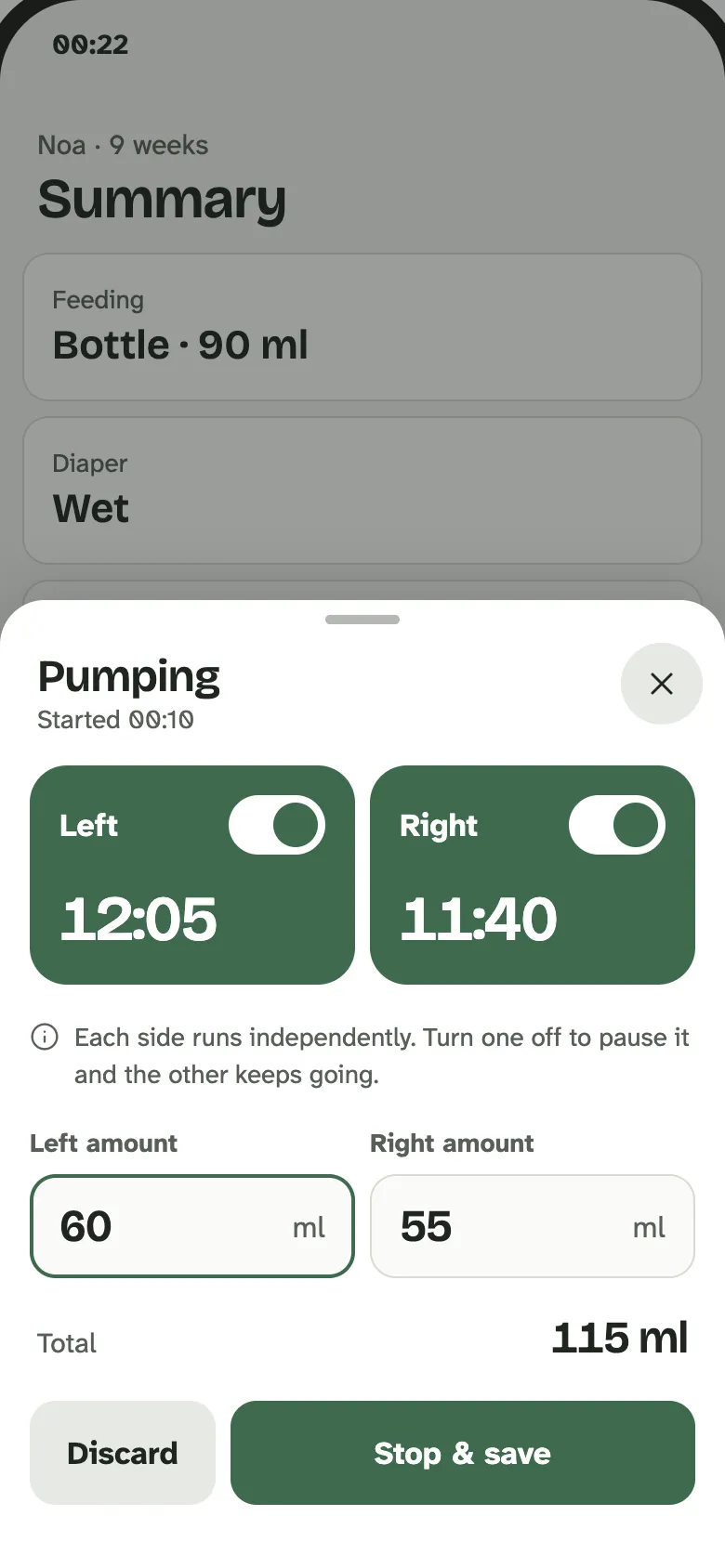
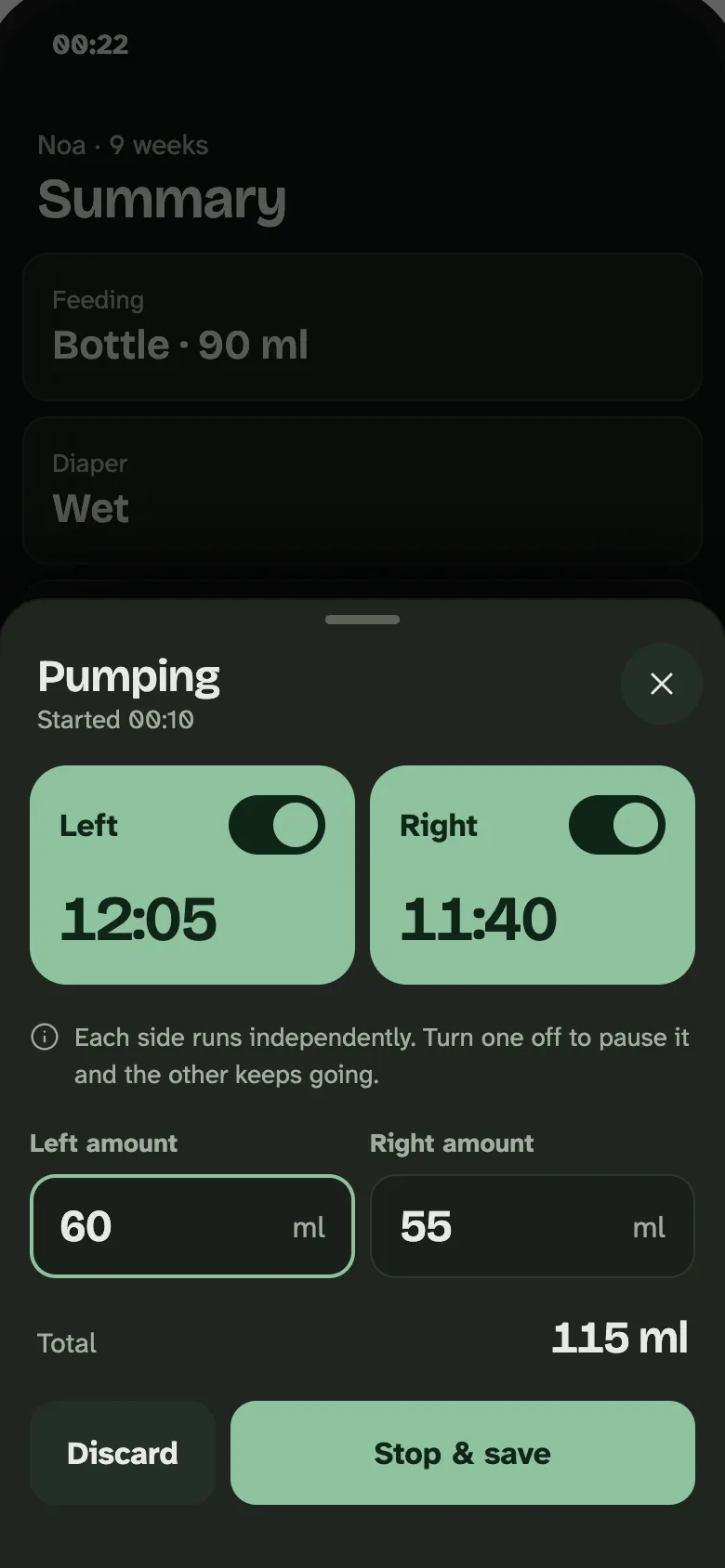
In Baby Tracker, the Pumping screen times each side on its own and adds up the amounts, and the daily total shows in the Timeline. Every entry shows who logged it, so the person giving the bottle can see the latest session without asking.
How often people express
How often you pump depends on why you are doing it. The NHS page on expressing says this plainly: the frequency and amount depend on your reason for expressing. Someone pumping one bottle for an evening out has very different needs from someone who pumps for every feed.
If your baby is not feeding at the breast yet and you are building or keeping up your supply, guidance from Cambridge University Hospitals NHS Foundation Trust suggests:
- Express at least 8 to 10 times in 24 hours.
- Express at least once between midnight and 6am, because the hormones that make milk are higher at night.
- Avoid gaps longer than 4 hours during the day and 6 hours at night.
- The sessions do not have to be exactly every three hours. You can fit them around your day.
A log makes this easy to check. Count the sessions in the last 24 hours and look for the longest gap, especially overnight. If your midwife, health visitor or lactation specialist has given you a different plan, follow theirs.
How long expressed milk keeps
This is where advice differs between countries, so check the guidance where you live.
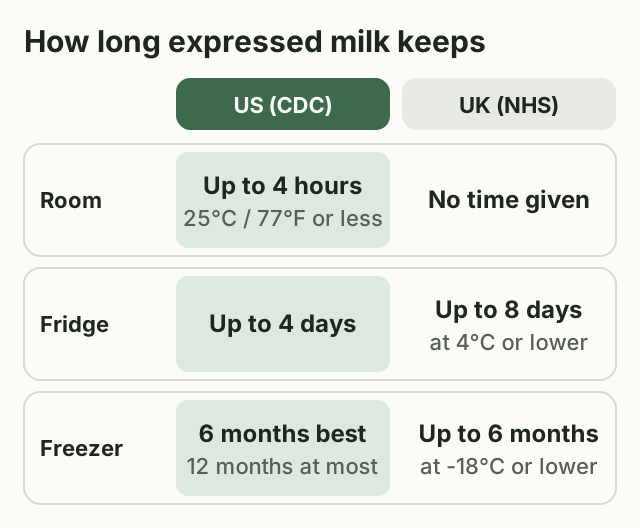
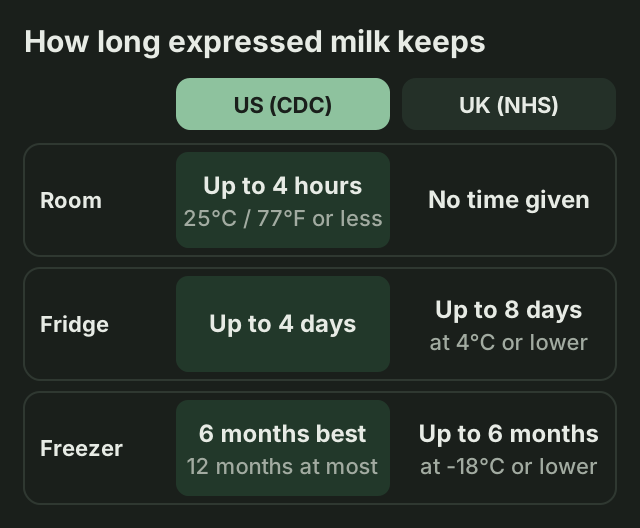
In the US, the CDC says freshly expressed milk keeps:
- at room temperature (77°F or colder) for up to 4 hours
- in the fridge for up to 4 days
- in the freezer for about 6 months as best, and up to 12 months as acceptable
The CDC adds: freeze it straight away if you will not use it within 4 days, and keep it away from the fridge or freezer door.
In the UK, the NHS says expressed milk keeps:
- in the back of the fridge for up to 8 days at 4°C or lower, or 3 days if you are not sure your fridge stays that cold (or it runs between 5°C and 10°C)
- in the ice compartment of a fridge for 2 weeks
- in a freezer at -18°C or lower for up to 6 months
The NHS page does not give a time for room temperature, so in the UK it is simplest to refrigerate milk soon after pumping.
Thawed milk and leftovers
The rules for milk that has already been frozen or offered are shorter:
- Never refreeze milk that has thawed (CDC and NHS).
- Milk thawed in the fridge: the CDC says use it within 24 hours of it being fully thawed. The NHS says to use thawed milk straight away.
- Milk brought to room temperature or warmed: the CDC says use it within 2 hours.
- Leftovers after a feed: the CDC says use them within 2 hours of the baby finishing, then throw them away. The NHS says use a bottle your baby has drunk from within 1 hour and discard what is left.
Labels and first in, first out
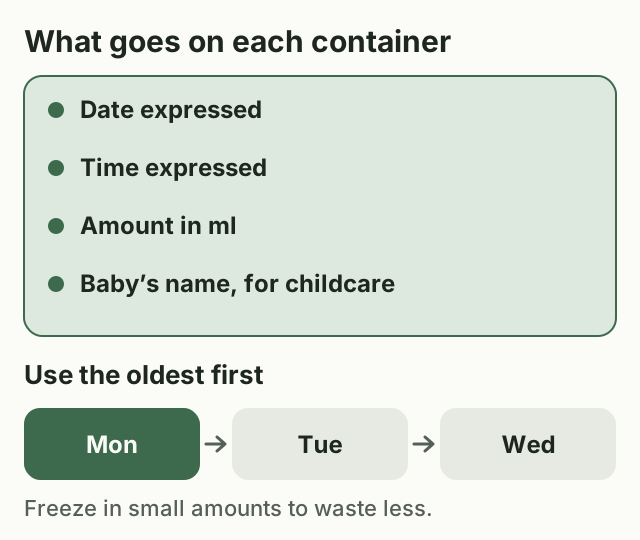
The CDC says to label each container clearly with the date the milk was expressed, and to thaw the oldest milk first. The NHS asks you to label and date milk before you freeze it. If the milk goes to childcare, the CDC adds the baby’s name.
A few habits make this easier:
- Write the same time on the container as in the log, so the two always match.
- Freeze in small amounts. The CDC suggests 2 to 4 ounces (about 60 to 120 ml) per container, leaving about an inch at the top because milk expands as it freezes.
- Use storage bags made for breast milk or clean, food grade containers with tight lids. The CDC warns against disposable bottle liners or bags not meant for milk.
- Put new milk at the back and take from the front, so the oldest is always within reach.
Agree on one spot in the fridge for milk to use next. The person who pumps puts the oldest container there. The person who feeds never has to search.
How your partner uses the log to make up a bottle
When the log is up to date, the bottle-giving parent can work alone:
- Check the log. See when the last session was and how much there is. This also tells them whether you will need to pump again soon.
- Pick the oldest container that is still within the storage time for where you live.
- Thaw it gently if it is frozen. The CDC suggests the fridge overnight, a bowl of warm water or lukewarm running water. Both the CDC and the NHS say never to thaw or heat milk in a microwave, and the NHS adds not on the stove.
- Warm it only if needed. The CDC says breast milk does not need warming, and the NHS says you can give it straight from the fridge if your baby is happy to drink it cold. If you warm it, the NHS suggests a jug of warm water to body temperature, and the CDC suggests testing a few drops on your wrist.
- Log the feed and the amount, so the next person knows when the baby last ate and how much is left in the fridge.
This turns night handovers into reading rather than talking. The person who pumped can sleep, and the person feeding has everything they need on one screen.
Sources
- Breast Milk Storage and Preparation, CDC
- Expressing and storing breast milk, NHS
- Golden Rules for expressing your milk if your baby is not latching at your breast yet, Cambridge University Hospitals NHS Foundation Trust
All sources accessed 14 October 2026.
Common questions
How often should I pump if my baby is not feeding at the breast yet?
Cambridge University Hospitals NHS guidance says to express at least 8 to 10 times in 24 hours, including at least once between midnight and 6am, and to avoid gaps longer than 4 hours by day and 6 hours at night.
How long can expressed milk stay in the fridge?
The CDC says up to 4 days. The NHS says up to 8 days at the back of a fridge at 4°C or lower, or 3 days if you are not sure your fridge stays that cold.
Can I refreeze milk that has thawed?
No. Both the CDC and the NHS say never to refreeze breast milk once it has thawed.
Does expressed milk need to be warmed?
No. The CDC says breast milk does not need warming, and the NHS says you can give it straight from the fridge if your baby is happy to drink it cold.
This guide is general information, not medical advice. Talk to your midwife, health visitor or doctor about your baby's health.